Tax Credit Transferability
Overview
This report summarizes the tax credit transfer marketplace as of the first quarter of 2025 and is based on a literature review and three interviews with individuals in leading law firms, banks, and development companies within the renewable energy space. The findings of this analysis are used to inform U.S. financing cost benchmarks for renewable and conventional energy technologies. The benchmarks are intended for use in the National Laboratory of the Rockies’s Annual Technology Baseline (ATB), a cross-technology modeling and analysis framework of current and projected future cost of electric generation and storage technologies.
Since 2023, eligible taxpayers have had the ability to transfer certain tax credits related to electricity generation and the manufacturing of products related to electricity generation (among other credits), to unrelated taxpayers in lieu of using those credits against their own Federal income tax liabilities ((Federal Register, 2023)).[1] In 2024, most financial transactions that included tax credits related to electricity generation involved renewable energy generation assets that elected either a production tax credit (PTC), from Section 45 or Section for 45Y of the tax code, or an investment tax credit ITC), from Section 48 or Section 48E of the tax code; asset owners transferred approximately half of those credits to other taxpayers. Additionally, a sizeable minority of credits were related to manufacturing (45X), electricity production from nuclear power (45U), and carbon capture and sequestration (45Q).
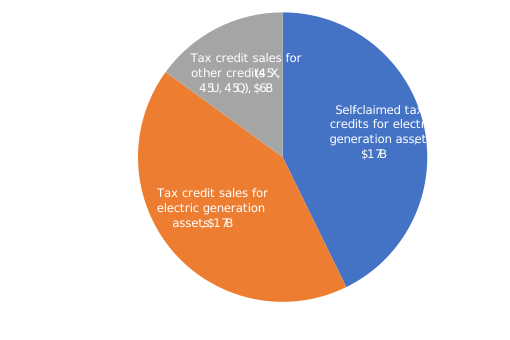
2024 Tax Credit Market related to Electricity Generation
Source: (Norton Rose Fulbright, 2025)
Market Participants
Interviewees stated that in 2024 the $15B to $20B transfer market was bifurcated into small and large transactions. The small transactions occurred between smaller businesses and often involved a trading platform. Transactions typically ranged between $0.5M to $3MM and the sales price of the credits were at a larger discount to the value of the credit than larger tax credit transactions, due to access to fewer buyers and the relatively fixed cost of closing the transaction (spread over fewer dollars of credit). Larger transactions, which represented the majority of the transferability marketplace, consisted of tax credits from large projects or a large portfolio of smaller projects. Similar to ownership structures before transferability was permitted, the majority of electricity generation assets were owned by Independent Power Producers (IPPs) and tax equity investors (typically banks and insurance companies). The law allows taxpayers to sell all or a portion of the credits, with many tax equity investors retaining and using many of the credits generated by their projects. Credit buyers comprised traditional corporations, like those in the Fortune 100 and Fortune 200, such insurance companies, oil and gas companies, big box stores, grocery store chains and media companies.
Market Pricing
As mentioned previously, the size of the transaction is a big determinant on the price, though other factors are determinants as well. These factors include:
PTC v ITC: the ITC is typically traded at a deeper discount to the credit value than the PTC because the ITC has a recapture risk (i.e., risk that some portion of the credit will need to be paid back to the IRS if there is a change in ownership to the project in the first five years) and the risk the IRS may challenge the cost basis used to calculate the credit (like was done in Alta Wind (U.S. Government Publishing Office, 2023a) and Bishop Hill (U.S. Government Publishing Office, 2023b)). Interviewees reported that standard, large-scale tax credit transfers from credit-worthy sellers owning solar and wind assets sold between $0.91 to $0.92 for every $1 of Investment Tax Credit transferred and $0.93 to $0.94 for every $1 of Production Tax Credit transferred.
Insurance/indemnity/credit risk: whether a credit is transferred or not, most non-investment-grade electric generation asset owners opt to procure tax credit insurance; in the case of a tax credit sale, sellers procure insurance to receive a higher price from the buyer. Tax credit premiums were reported to be around 2%-3% of the cost of the credit. Additionally, investment-grade sellers also often receive a higher purchase price than non-investment-grade sellers due to less perceived risk in the transaction. Interviewees reported there was a potential 5% difference in value of the credit between an investment-grade and non-investment-grade seller when adding the cost of insurance with the lower purchase price of have a lower credit-rating.
Technology: interviewers were uncertain of the reason behind the differences in pricing due to technology, but noted that credits on storage projects were trading 2% above wind and solar projects, and nuclear projects were receiving the highest pricing (1% above storage), all else being equal.
Payment timing: IRS regulations do not allow buyers to pay for credits prior to the year they are accrued (Section 1.6418(f)(2) (Federal Register, 2023)), however interviewees reported seeing some forward contracts on the PTCs, selling several percentage points below single-year tax credit sales.
Other Considerations
The amount of debt a project can raise is based on its cash flows. Tax credits allow projects the ability to enter into lower-priced electricity contracts because the lower cash flow received from those contracts is made up for by the increased corporate cash flows from the tax credits, or in the case of transferability, cash payments for the transfer of those credits. Interviewees stated that for purposes of sizing a loan, banks generally value the credits at about 75% of the value of the cash payments for the credit transfer, though some of this depends on whether there is a forward contract for the credits (which would increase the value a bank would assign the credits). That said, as mentioned above, a forward-priced tax credit transfer typically trades at a discount, therefore, the increased value from the bank would be offset by the lower contracted price.
Conclusion
Given the plurality of electricity generation assets installed in the United States over the past five years have been owned by investment-grade IPPs partnering with large tax equity investors, and that approximately 50% of tax credits associated with electric generation assets in 2024 were transferred, we estimate that transferability lowered the average value of the ITC by 4% (i.e., 50% of the market multiplied by $0.92 for every $1 of ITC = 96%) and lowered the average value of the PTC by 3% (i.e., 50% x $0.94/$1 = 97%). Additionally, for purposes of sizing the debt within the ATB, we assume a 75% value of the PTC transfer price (i.e., 97% average value of the PTC based on transfer pricing multiplied by 75% = 73%).
[1] Each credit can only be transferred once.
References
The following references are specific to this page; for all references in this ATB, see References.